Power SMPS

Expand your power

Category: Introduction

  • What is the difference between a linear regulator and a switching regulator?

    What is the difference between a linear regulator and a switching regulator?


    Use a linear regulator if power stability is required

    Linear regulator, called series regulator or shunt regulator, are mainly used when precise voltages are needed or when small power is needed, and when the unit price of the product has to be lowered. Linear regulator have very small electrical noise generation in a simple circuit configuration and have a small output ripple voltage, allowing them to configure high-stability power sources.

    However, a linear regulator uses a transistor to create a difference between an input voltage and an output voltage, resulting in a large power loss when the output current is large. Since all power losses are generated by heat, heat dissipation measures such as heat sinks are needed not to exceed the rated operating temperature. Therefore, when high output is required, power loss increases, making it difficult to use.
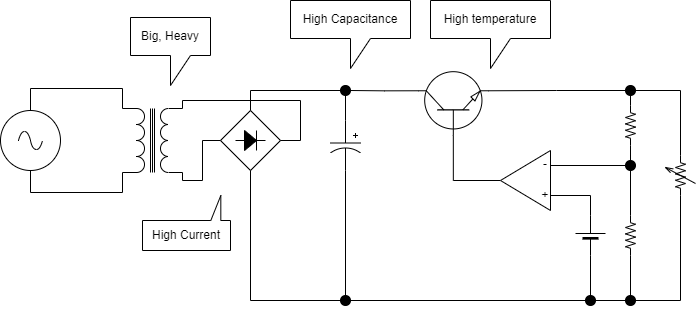
    Disadvantages of Linear Regulator
    Disadvantages of Linear Regulator

    Use switching regulators when high efficiency power is required

    Switching regulators are mainly used when high-efficiency power is required or when circuits need to be miniaturized. For example, since heat loss in linear regulators can be solved by switching loss in switching regulators, the power conversion efficiency is high and the area required for heat dissipation is small.

    In addition, the lower the operating frequency, the larger the size of the power transformer, so the linear regulator that converts 50/60Hz, which is a commercial power source, has a big and heavy power transformer. On the other hand, switching regulators can make the operating frequency several tens of kHz or more, making the transformer used for power conversion smaller and lighter.

    In addition, the linear regulator must make a DC voltage by dropping and rectifying the voltage by a transformer of commercial power. Therefore, the output current flows through the rectifying circuit as it is, and the loss of the rectifier diode is large, and the smoothing capacitor must also be large. However, the switching regulator uses a direct current voltage that directly rectifies commercial power, so the loss of the rectifier diode is small due to the small current, and the smoothing capacitor can be used small with an operating frequency of several tens of kHz or more.

    However, switching regulators are complicated in circuit configuration and operation. In addition, measures to reduce noise caused by switching are needed.

    Linear RegulatorSwitching egulator
    Step Down(Buck)
    Step Up(Boost)
    Buck-Boost
    Invert
    O
    X
    X
    X
    X
    X
    X
    X
    EfficiencyLowHigh
    Output CurrentLowHigh
    NoiseLowHigh
    DesignSimpleComplicated
    CostLowMiddle

    Recently, switching regulators are mainly used

    Recently, circuit integration technology has developed, and circuits that require complex functions are implemented as one IC. Switching regulators are also able to configure high-efficiency switching regulators with only a few peripheral circuit configurations. Of course, the types of parts depending on the use are also subdivided.

    However, if the method of using such an IC is not accurate, it may cause accidents such as a decrease in reliability or damage to parts. Therefore, the design of switching regulators is very important.
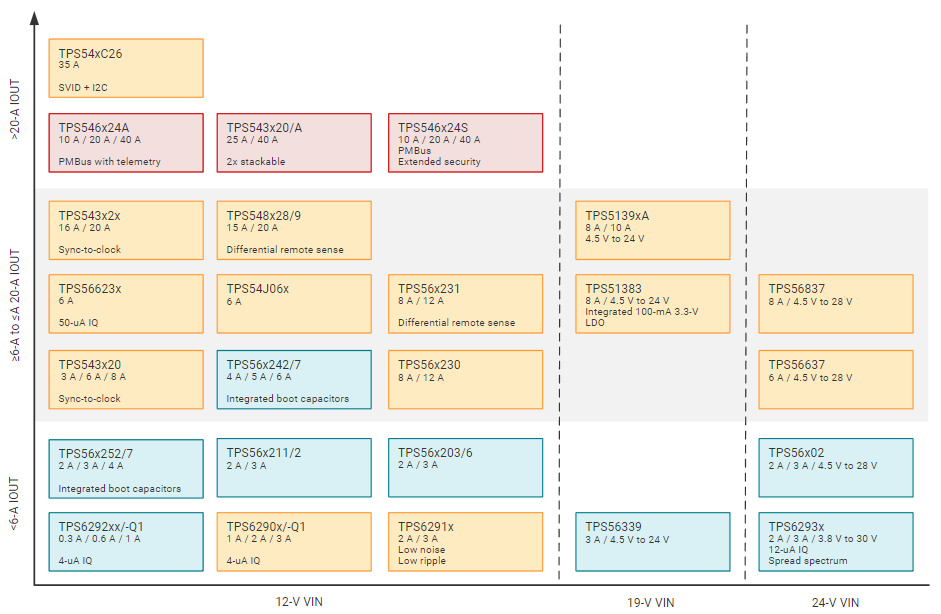
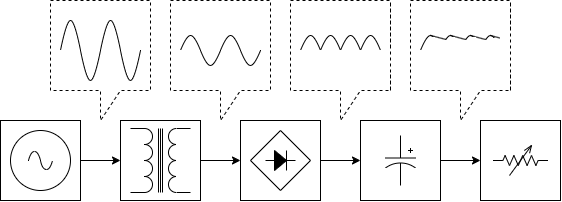
    Examples of switching regulators by TI (link)
  • Why do electronic circuits need regulated power supply?

    Why do electronic circuits need regulated power supply?


    The electronic circuit operates on DC power

    All electronic devices require power supply through an AC 110V/220V voltage which is a commercial power system(or a battery) for the operation of the device. In addition, these electronic devices require stable power sources such as 3.3V, 5V, and 12V.

    Electronic devices supplied with power through commercial power supply convert and rectified voltage to the required value by the power transformer to create a DC voltage and use it in a circuit. However, in a rectified DC power source, the performance of the device cannot be fully demonstrated because the stability and precision of the voltage are not good due to changes in the input voltage or a voltage drop of a transformer or rectifier diode.


    Causes of voltage fluctuations

    Quality of commercial power supply voltage

    Commercial power fluctuations exist even in countries with very good power systems using sufficient costs for power plants, etc. Most of them have small fluctuations of around ±5%, but some countries under development have a very large voltage drop of more than 10-20V.

    Power Transformer Voltage Drop

    Although it depends on the size of the transformer, a voltage drop occurs depending on the resistance of the wire because the copper wire is wound more than hundreds of times. In addition, since the leakage inductance between the primary and secondary of the transformer is inserted in series, a voltage drop occurs.

    Voltage drop in rectifier diode

    Bridge diodes, which are widely used for rectification, have forward voltage drops depending on the current

    Ripple Voltage

    Since the AC voltage of the commercial power source is sinusoidal, ripple voltage occurs due to charging and discharging even if it is smooth with a rectifier capacitor. This is represented by voltage fluctuations of twice the frequency in the case of full-wave rectification. In addition, when a load fluctuation occurs, a larger ripple voltage fluctuation occurs due to the imbalance of charging and discharging of the rectifier capacitor.

    full_wave_rectifier
    Full-wave rectifier

    Electronic circuits require a rated voltage

    All electronic components, such as motors and relays, as well as semiconductors such as ICs, have a rated voltage that is recommended to be used and a maximum voltage that guarantees operation. Therefore, if the voltage value is exceeded, the electronic component may not operate as designed, have a shorter lifespan, or may be damaged.

    For example, the rated voltage of most TTL ICs is 5V, the voltage that guarantees the operation is 4.5 to 5.5V, and the maximum voltage is 6 to 7V. In addition, in signal amplification circuits such as OPAMP, supply voltage fluctuations become signal fluctuations or noise. As a result, the designed precision or stability cannot be obtained.

    As such, the fluctuation of the power voltage is a problem to be solved in terms of the performance and reliability of the device. Therefore, power stabilization and regulated power supply are required through circuit design